SGUK Episodes 179 & 180
A Carefully Managed Public Mask
&
The_Cost_of_Emotional_Containment_Ep_180_15_Feb_2026
Hello, Ivy here.
This week’s podcast is a short recap of the previous episode with the title of A Carefully Managed Public Mask. That episode is very much linked with today’s episode, entitled The Cost of Emotional Containment. The remaining 4 episodes are all linked and the final episode will provide plenty of evidence, gathered and discussed, over the six podcasts that the actions or lack of actions over a very long period, combined with effort being placed on the wrong areas of the huge risks to the crown. The phrase risks to the crown is the arc that covers all six areas of discussion, with each point based on evidence and published research data.
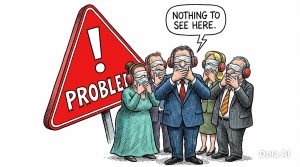
Due to illness, episode 179 did not have an article published. Please accept my apologies for that. I have now completed a combined article of episodes 179 and 180, which looks at the UK monarchy and the clear evidence that some members of the British Royal Family are clearly hiding behind a public mask, a mask which is trying to say all is OK, when I believe that the opposite is true. Episode 180 has a title of The Cost of Emotional Containment and we will explore the dangers of that process and the impact on mental health and the ripple effect of risk to the crown. The Monarchy currently lacks leadership and the future does not bode well, that things are likely to get any better. It is being in denial with an increasing tension between the top two, but in my mind, neither one of them is grasping the risks of the game they are playing.
I have researched some of the risks to the Crown, or the perceived risks to the Crown. The Crown as a structure, an institution, and all the stakeholders who want it to stay in place. not least because they receive a wage for their efforts. What would they do if the crown failed? History has shown us over many years that when the monarchy goes internal with their activity and give out a public persona, etc., it always ends badly. The erosion begins from within, out of sight, but the inevitable always happens. I have used research examples from recent and past papers to ensure that I do not just state my opinions. I have listed behavioural traits on display by the lead players in UK Monarchy. And that also does not bode well. The risks to the crown that they claim to love so much is in danger, and I do not think enough thought has been given to the implications. I am not a royalist, but I am being careful to use research data and not just state my opinion, or worse, rely on tabloid fodder. which in itself has different goals in mind. It is often said that a Monarchy is the only institution that dies from the centre out. My thoughts of the current climate has pointed out that it aligns with historical precedents, where the survival of a crown became secondary to the internal dynamics of those wearing it.
Here are a few paragraphs on the structural risks to the institution, the fallout of a potential failure, and historical parallels to help frame conclusions later on. First heading, the structural risks, a hollowed out institution. The greatest risk to the Crown today is not an external revolution, but institutional irrelevance caused by internal paralysis. When a Monarchy shifts its energy towards managing internal tensions rather than providing national leadership, the public mask begins to crack. In a constitutional monarchy, the sovereign’s power is entirely symbolic. That symbol’s value is predicated on the perception of stability. If the public perceives that the top two are more engaged in zero-sum game of personal standing than in the stewardship of the nation, The Crown ceases to be a unifying force and becomes a source of national friction. This creates a vacuum of soft power, where the institution’s silence, intended to project calm, is instead interpreted as a lack of agency, or worse, A state of denial.
- The stakeholder fallout, the wage of the crown. The crown is not just a family. It is a multi-billion pound corporate and civil structure. Beyond the royals themselves, thousands of people, from the Duchy of Cornwall’s estate managers and the household staff to the Metropolitan Police’s Protection Units, are professionally and financially tethered to its existence. If the Crown were to fail or be significantly hollowed out, the impact would ripple through.
- The civil service and constitution. The legal foundations of the UK, from the King’s piece in court to the granting of Royal Assent, would require a total chaotic overhaul. It would be like Brexit on steroids. in terms of legislative complexity.
- The charitable sector. Thousands of organisations rely on the Royal Seal of Approval for fundraising. Without the Crown’s patronage, the soft power infrastructure of the UK’s third sector would face a massive funding and visibility deficit. I’d like to just add here that I believe that environment is happening already and has been for some time. I don’t believe for one moment that the existence of a UK royal family has in any way enabled fundraising to such an extent that the majority of the charities are doing fine. I don’t believe that. I don’t believe that the evidence suggests that either but time will tell.
I think they’re already losing and we have all heard of increasing numbers who are actually losing money and closing down. So that particular bullet point, I think, is being more wishful thinking than factual. The same, I also believe, applies to this one,
- The Commonwealth. The crown is the thread holding 50 plus nations voluntary associations together. Its failure would likely trigger the immediate fragmentation of this global network. My thoughts on that particular bullet point is that the Commonwealth is in need of overhaul anyway. Things need to be reviewed, see what is still required, what can be done differently, and what can be stopped altogether. So regardless of what the monarchy is doing at the moment, I believe that the Commonwealth needs to revisit a number of things. On a personal note, I don’t actually see why the UK monarchy has to be seen as the head of things in the scene. I just don’t. I’ll just leave it at that. We’ll see what happens over the next few years.
- Historical precedent. The erosion from within. History shows that monarchies rarely fall because they are hated. They fall because they become functionally useless.
- One example, the Romanovs from Russia. In the years leading up to 1917, The internal mask was maintained, while the leadership was increasingly isolated and distracted by internal family crises. By the time the external pressure arrived, there was no internal strength left to resist it. The Bourbons from France.
- Louis XVI was not an evil man but he was a leader who failed to grasp the risks of the game. He remained in a state of internal focus while the world around him shifted.
- The Habsburgs from Austria and Hungary, their collapse was accelerated by a rigid adherence to all is well protocols that ignored the shifting loyalties of their diverse subjects. Next heading, the daylight theory. The famous warning from constitutional scholar Walter Bajon. Quote from him, “We must not let in daylight upon magic.” This podcast could argue that the current leaders are making a fatal mistake. They are letting in the wrong kind of daylight. Instead of the daylight of transparency and modern leadership, they are allowing the daylight of personal friction and internal erosion to be seen. Historically, once the magic of the crown is replaced, by the mechanics of a family feud, the institution loses its divine justification and becomes just another expensive, dysfunctional Department of State. The economic ledger, a crown of two halves, When discussing the wage for the Crown’s efforts, the numbers are often a point of fierce contention. To provide balance, it’s possible to present two primary ways the Crown’s cost is calculated today. The official view, the sovereign grant. For the financial year 2025-26, the sovereign grant is set to rise to £132.1m, a %53.53 increase from the previous year. This is largely due to record profits from the Crown’s estate, offshore, wind farms and the ongoing 369 million reservicing of Buckingham Palace. In contrast, the Republican view, in brackets, the true cost, close brackets, research groups like Republic argue the cost, the true cost, is closer to 510 million pounds per year. They include hidden costs such as the 150 million pounds security bill, lost revenue from the Duchess of Lancaster and Cornwall, which they argue are state assets, and the costs incurred by local councils for royal visits. The game versus the stakes. The risk to the crown isn’t just that the top two are playing a dangerous game of internal politics. It’s that they are playing it while standing on a financial and legal trapdoor. If the mask slips far enough that the public demands a republic, We aren’t just talking about changing a face on a stamp. We are talking about a multi-billion pound constitutional divorce at a time when the nation’s cupboards are already bare. History tells us that when a monarchy goes internal, it stops earning its keep, and in 2026, an institution that costs half a billion pounds, while providing no clear leadership, is an institution living on borrowed time. The lead players may love the crown, but by failing to lead, they are essentially writing the invoice. for its abolition. If the monarchy is a public mask, then the behavioural traits of its lead players are the cracks through which the public sees the reality. Here’s an outline of a behavioural audit, or rather a list of behavioural traits that could be audited, that focuses on how leadership traits, or the lack thereof, translate into institutional risk. Let’s have a look at a simplified version of a behavioural audit. The personality trap. when private grievance outpaces public duty.
Theme: The Personality Trap—When Private Grievance Outpaces Public Duty.
- The “Fortress Mentality” (The Lead Player A)
This trait involves a retreat into a small, trusted circle, viewing any external critique or modernizing suggestion as an act of betrayal.
- The Risk: It creates an information vacuum. Historically, leaders who “go internal” stop receiving honest feedback.
- The Podcast Angle: Analyze how this “Fortress” behavior prevents the Crown from adapting to the 21st century, making it look defensive rather than resilient.
- The “Legacy Obsession” (The Lead Player B)
This is the tendency to prioritize one’s future “place in history” or personal brand over the immediate stability of the current reign.
- The Risk: It creates competing narratives. When two leaders are seen to be “auditioning” for different versions of the Monarchy, it signals a house divided.
- The Podcast Angle: Contrast this with the late Queen Elizabeth II’s trait of “Self-Effacement”—where the individual disappeared so the Crown could shine.
- The “Communication Paradox”
This is the trait of being “seen but not heard,” but in a way that feels manipulative rather than stoic. Using briefings and “sources” to fight internal battles while maintaining a silent public persona.
- The Risk: Loss of Trust. Research shows that Gen Z and Millennials value “authentic” transparency over “curated” mystery. By playing the “game” through the press, the leads risk being seen as politicians rather than symbols.
Comparative Analysis: The “Cycle of Decline”
To provide the research-based “balance” use this table to show how certain behaviors have historically signaled the end of a regime:
| Behavioral Trait | Historical Example | Modern Parallel/Risk |
| Inaccessibility | Louis XVI (France) | The “Public Mask” feeling like an “Invisible Wall.” |
| Factionalism | The Wars of the Roses | Internal competition for resources/public favor. |
| Reactionary Delay | Nicholas II (Russia) | Waiting too long to address “Game-Playing” risks. |
| Preference for Flattery | The Kaiser (Germany) | Dismissing critics as “anti-royalist” rather than listening. |
To ensure that this podcast, and in fact the whole of this series of podcasts, is evidence-based, there are a few that I’m just going to quote in the next few lines, looking at recent downward trends in institutional trust across the UK and there are at the end of this article a list of reference sources, the names and dates and names of people who’ve written research papers, the dates when they were published and the institution where they did and published that study. There are some really, really good locations on there and once you go on any of those you’ll find that they then break down into even more reference sources.
- The “Importance” Deficit (NatCen Data)
The National Centre for Social Research (NatCen), which produces the British Social Attitudes survey, provides perhaps the most sobering data for the Crown.
- The “Historical Low”: As of late 2025/early 2026, support for the monarchy has hit its lowest level since records began in 1983.
- The Trend: In 1983, 86% of people said it was ‘very’ or ‘quite important’ for Britain to have a monarchy. By 2024, that fell to 51%, and latest indicators suggest it is struggling to stay above the 50% “majority” mark.
- The “Abolition” Spike: For the first time, nearly 4 in 10 (38%) would prefer an elected head of state when asked to choose directly.
Podcast Insight: We could argue that while “The Mask” projects stability, the public’s belief in the necessity of the institution is evaporating. It is transitioning from a “national cornerstone” to an “optional extra.”
- The Generational Fissure (YouGov 2026)
YouGov’s most recent Favourability Trackers (January 2026) highlight a behavioral “blind spot” in the Crown’s leadership.
| Group | Support for Monarchy | Preferred Elected Head |
| Aged 18-24 | ~30% | ~59% |
| Aged 65+ | ~77% | ~15% |
- The Leadership Gap: While the Prince and Princess of Wales remain popular (74-77%), the King’s favourability sits at 60%, and Queen Camilla’s has dipped to 42% (her lowest since 2021).
- The “Andrew Effect”: 90-91% of the public view Prince Andrew negatively. My “Game Playing” theory can be supported here: the King is seen by 32% of the public as having handled this internal crisis “badly,” suggesting the public senses the internal friction.
- Sociological Context: The “Crisis of Representative Institutions”
To add academic depth, you can reference the “Crisis of Political Trust” framework (often cited by researchers at LSE or in the British Journal of Political Science).
- “Implementing” vs. “Representative” Trust: Globally, trust in “implementing” institutions (like the police or NHS) is volatile, but trust in “representative” symbols (like Parliament or the Monarchy) is in a steady, long-term decline across Western democracies.
- The “Neutrality” Trap: Academic papers (e.g., Bjørnskov 2025) often argue that Monarchies survive because they are seen as “neutral.” Your podcast can argue that the “Lead Players” are currently destroying their neutrality by engaging in what the public perceives as partisan or personal internal warfare.
The SGUK channel values the “why” behind the “what.” Integrating academic frameworks transforms the discussion from commentary into a psychological and sociological study of institutional decline.
Here are four specific academic concepts and research-backed “behavioral markers” that support the theory of internal erosion and the danger of the “Public Mask.”
- The “Relational Contract” Failure
In economic and political theory (specifically Besley & Kudamatsu, LSE), hereditary rule is viewed as a “Relational Contract.” The public allows the family to keep their status in exchange for a “reputation” of stability and high performance.
- The Behavioral Marker: When leaders engage in internal “game-playing” (Briefings, leaks, or factionalism), they are essentially breaching the contract.
- The Risk: Research shows that hereditary systems are significantly more likely to collapse when the “incumbent’s performance is poor.” Unlike a politician who can be voted out, a failing Royal “Relational Contract” usually leads to the total rejection of the institution itself.
- “Surface Acting” vs. “Deep Acting” (Psychology of the Mask)
Sociological research into leadership (e.g., Grandey et al.) distinguishes between Surface Acting (faking a public persona/the Mask) and Deep Acting (actually aligning one’s internal feelings with the role).
- The Behavioral Marker: High levels of “Surface Acting”—where the “top two” project unity but internally harbor tension—leads to Emotional Exhaustion and “Depleted Leadership.”
- The Risk: A “depleted leader” is statistically more likely to make passive or erratic decisions. Your observation of a “Public Mask” suggests the institution is currently in a state of high-stress Surface Acting, which history shows is unsustainable and often precedes a public breakdown.
- The “Fortress Mentality” & Information Silos
Academic studies on Institutional Trust (e.g., National Centre for Social Research) indicate that modern public trust is built on Transparency, not Mystery.
- The Behavioral Marker: The “Fortress Mentality” (retreating into a small, defensive circle) creates an Information Vacuum.
- The Risk: In the absence of direct leadership, the public fills the vacuum with their own (often negative) narratives. This is the “Daylight Theory” in action: when you don’t provide the right kind of “light” (leadership), the public lets in the “wrong” kind (speculation and scandal).
- The “Integrity-Trust” Correlation
Research from Psychological Perspectives on Leadership confirms that “Behavioral Consistency” is the #1 predictor of follower trust.
- The Behavioral Marker: If the public perceives a gap between the Monarchy’s espoused values (Duty, Service, Unity) and their actual behavior (Internal rivalry, legal battles), Institutional Integrity collapses.
- The Risk: As per Yukl (2013), once “espoused values” are seen as a mask for “private interests,” the trust is almost impossible to regain.
Evidence-Based Table
This table can be used to summarize the “Evidence vs. Observation”:
| Observed Behavior | Academic Framework | Institutional Risk |
| Public Mask of Unity | Surface Acting (Grandey) | High burnout; eventual public “crack.” |
| Internal Rivalry | Relational Contract (Besley) | Breach of the public’s “unspoken deal.” |
| Defensive Secrecy | Information Silo Theory | Irrelevance and loss of “Neutrality Shield.” |
| Inconsistency | Integrity Correlation (Yukl) | Permanent loss of public trust/consent. |
Conclusion
Could be argued that while the mask the 51% still represents a slim majority. The intensity of that support has vanished. People are indifferent and indifference is the precursor to institutional failure. This is about the establishment loyalty and it’s referring to where royalists generally feel very comfortable that the monarchy will always be there, if not least because the establishment will make sure that they are there. They are all sort of one and part of the same group. So this is referring to that establishment loyalty element. To back up the argument that the establishment is a fair-weather friend, it states that some people may wish to look into it in more detail to see whether or not that is in fact the case.
The 1946 Italian referendum – Despite the King’s establishment support, the public voted for a republic because the Crown was seen as having played games during the war. The relational contract. Academic papers explains that the elite only support a hereditary leader as long as that leader maintains public order. If the public becomes indifferent or hostile, the elite will pivot to a republic. to save their own positions. I think the King and the Heir, and possibly the courtiers, are in denial and it frustrates me, that’s me personally, the amount of funding which goes to people who just assume all will always be okay, regardless of what is going on and what is happening.
There is a specific psychological phenomenon often seen in long-standing institutions called Institutional Narcissism, where the leadership becomes so convinced of their own necessity that they view public indifference not as a warning, but as a lack of education on the part of the public. I will just say here that we have a future podcast coming up and that is the title of it, Institutional Narcissism.
The King and the Heir are currently banking on loyalty that is historically transactional. The establishment isn’t a bodyguard, it’s a mirror. While the courtiers tell the leadership that the mask is secure, the economic data shows a nation that is increasingly unwilling to pay for the upkeep of an institution in denial. When the heir assumes the establishment will always be there, he forgets the cardinal rule of power. The elite only support a crown until it becomes a distraction. In 2026, with youth support in free fall, the crown is becoming a very expensive distraction indeed. In academic terms, institutional narcissism occurs when an organisation becomes so enamoured with its own history, prestige and specialness that it loses the ability to process external reality. It stops being a tool for the public and becomes a shrine to its own survival. Research isn’t just about opinions, it’s about the science of leadership. When the data shows a 40-year low in institutional trust, it’s a direct response to what psychologists call ‘surface acting’. The crown is wearing a mask that no longer fits, and as history and academia tell us, an institution that prioritizes its internal games over its public contract is an institution preparing for its own exit.
A closing thought, the end of which this podcast will finish. The air’s greatest mistake is confusing the establishment with the public. The establishment is a mirror that reflects whatever the current power structure wants to see. But YouGov and the National Centre of Research Data is a window into the reality outside the palace gates and that window shows a generation that doesn’t hate the king. They simply don’t see the point of him. Arrogance in the face of indifference is not a strategy for survival. It is a blueprint. for a quiet exit.
That’s the end of this week’s podcast. I hope you found that interesting, informative. As I said at the beginning, this article is quite long because it covers 2 podcasts, as I was ill with the last one. I did the podcast, but I didn’t get around. to finishing the article. So it’s quite long but full of detail and I do actually think that this article that will be out on Sunday or Monday (22/23 Feb 2026) is worth keeping because I very much believe that there are a number of things that have been referred to in this article and previous ones that we’ve done in recent months – things are going to start happening and you could almost tick them off as being, yeah, that was on the list/ that’s happened now, and so on. A number of things are going to be going on the next few years. So thank you very much for being here. Thank you very much for listening, even through all the ones that I was doing, quoting figures and from the tables and trying to make them as interesting as possible, the better off when you actually look at the article and read it for yourself. Thank you for your support, particularly when I was not well and I’m not in good health as a general thing at the moment as you all know, so it’ll be up and down. But I’ll do my best to keep this going. So just to say thank you and look forward as usual to your comments Sunday night onwards.
So, it’s bye from me, bye from Ivy, bye.

Ivy Barrow
15th Feb 2026
NEXT 2 PODCASTS WILL AIR ON 1ST & 15th MARCH @ 8pm GMT
REFERENCE SOURCES (Recommended)
- National Centre for Social Research (NatCen): British Social Attitudes 41 (2024/25) – “Royal Reflections: Shift in Public Opinion.” (Crucial for the 86% vs 51% stat).
- YouGov Political Research (Jan 2026): Royal Family Favourability Trackers. (Crucial for the Queen Camilla and King Charles approval dips).
- House of Commons Library (Dec 2025): Briefing Paper CBP-9807: “Finances of the Monarchy.” (Crucial for the £132.1m Sovereign Grant figure).
- Clancy, L. (2021): Running the Family Firm: How the Monarchy Manages its Image and Our Money. (Academic book exploring the “Corporate Mask”).
- Grandey, A. A., et al. (2013): Emotional Labor in the 21st Century. (Academic framework for the “Surface Acting” vs. “Deep Acting” theory).